Austrian Colonel: SAMP/T Cannot Replace Patriot in Ukraine’s Air and Missile Defense
The Franco-Italian SAMP/T air and missile defense system cannot replace the U.S.-made Patriot, as Europe currently produces only 100–150 interceptor missiles per month for SAMP/T and other European air defense systems – far too few to support effective air and missile defense operations.
Markus Reisner, a colonel in the Austrian Armed Forces’ General Staff, military historian, legal scholar, and head of the Institute for Basic Officer Training at the Theresian Military Academy, stated this in an interview with German broadcaster n-tv.
The missile shortage is being addressed by MBDA, which announced in March that it would increase production of its Aster interceptor missiles by 40%. The Aster family is used by the SAMP/T system, the only European-made alternative to the U.S. Patriot air and missile defense system.
“About 650 Patriot surface-to-air missiles are produced each year. Europe could help make up the shortfall by manufacturing a system similar to the Patriot: the SAMP/T. However, only around 100–150 SAMP/T surface-to-air missiles are produced annually. European production has not increased since the start of Russia’s full-scale invasion. Yet such an increase would be necessary both to support Ukraine and to replenish national stockpiles,” Markus Reisner said.
Reisner zum zentralen Problem von
SAMP/T als Patriot Ersatz: „Es werden pro Jahr nur circa 100 bis 150 Stück der SAMP/T-Fliegerabwehrraketen hergestellt. Die Produktion wurde seit Beginn der russischen Invasion nicht gesteigert.“ https://t.co/rs0xUX9SRz
— Björn Müller (@Bjoern__M) July 7, 2026

Alongside the delivery of SAMP/T NG systems, NATO planners have expanded production of Patriot Guidance Enhanced Missile–Tactical (GEM-T) interceptors through the COMLOG joint venture in Schrobenhausen, Germany. In April 2026, RTX signed a $3.7 billion direct commercial sales contract to supply GEM-T interceptors to Ukraine, with the deal being funded largely by the German Ministry of Defense.
GEM-T is a PAC-2 blast-fragmentation interceptor, not a PAC-3 hit-to-kill interceptor. It is highly effective against aircraft, cruise missiles, and older tactical ballistic missiles, but it is not designed to defeat highly maneuverable threats such as the Iskander-M or the Kinzhal. As a result, the large-scale procurement of GEM-T interceptors through the COMLOG program does not solve the shortage of missiles for the SAMP/T system.
In practice, this reflects a trade-off: accepting lower capability against the most advanced ballistic threats in exchange for much higher production volumes. The aim is to keep Ukraine’s Patriot batteries supplied with interceptors capable of defeating most Russian air threats, while preventing depletion of NATO air-defense missile stockpiles. The consequence, however, is that responsibility for countering advanced ballistic missiles shifts almost entirely to the European SAMP/T NG system.
On July 7, European NATO allies signed several agreements with U.S. defense manufacturers covering key air defense programs. These include the procurement of FIM-92 Stinger missiles, a feasibility study to expand Raytheon’s AIM-120C-8 AMRAAM missile production in Europe, and the establishment of a European maintenance and support center for PAC-3 interceptors used by the Patriot air defense system. Taken together, these initiatives indicate a broader shift in Europe’s integrated air and missile defense doctrine, with greater emphasis on expanding domestic production, sustainment, and long-term logistical resilience.
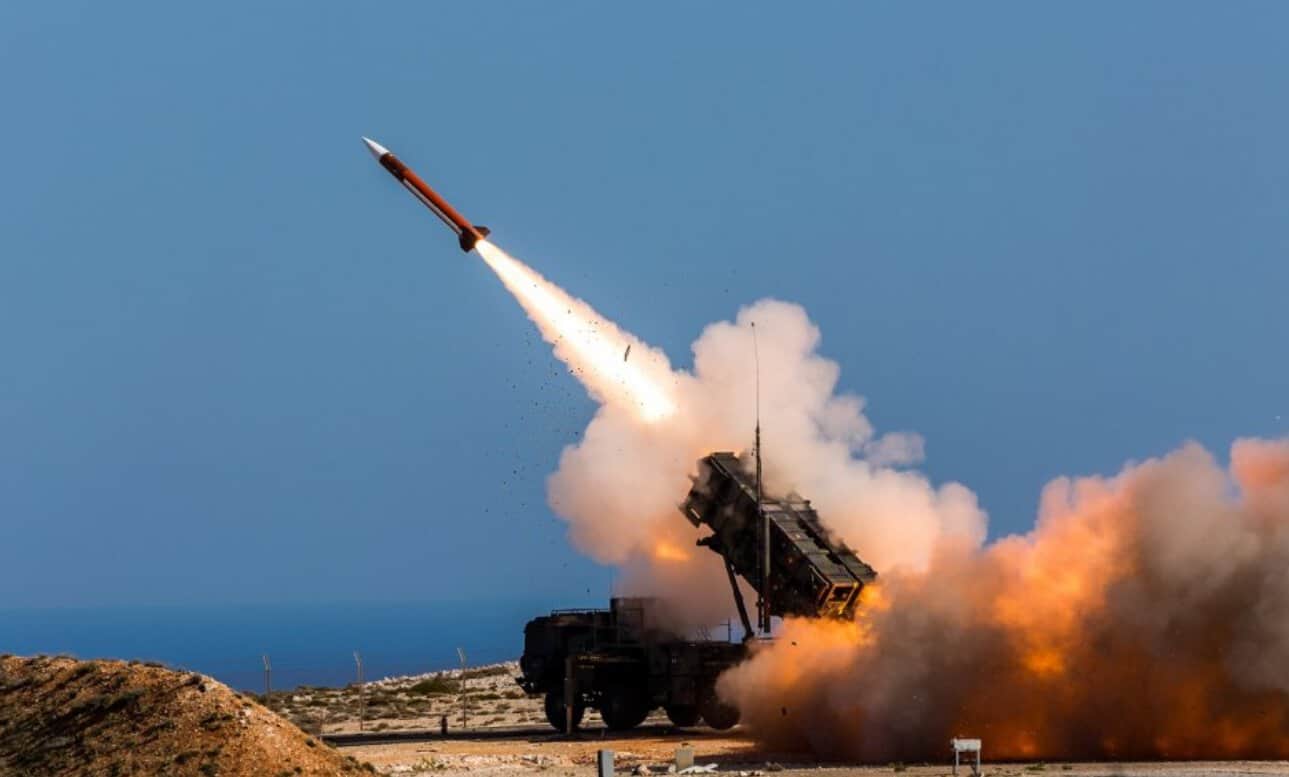
SAMP/T and the SAMP/T NG
The SAMP/T NG is a fully mobile surface-to-air missile system mounted on an 8×8 wheeled chassis. It is equipped with either the GF300 radar or the Kronos Grand Mobile High Power radar, both of which use active electronically scanned array (AESA) technology based on gallium nitride (GaN) transmit/receive modules. The radar provides continuous 360-degree coverage without mechanical rotation, detecting targets at ranges exceeding 350 km, tracking more than 1,000 targets simultaneously, and responding within seconds.
A crew of approximately 20 personnel operates the complete battery, although only 2–4 operators are required to control the radar and command post once the system is deployed. The system is transportable by a C-130 transport aircraft and can be brought into operation in approximately 15 minutes.
The Aster 30 interceptor – upgraded to the Aster 30 Block 1 NT (B1NT) standard in the SAMP/T NG – accelerates to approximately Mach 4.5 and is launched vertically from canisterized launchers, each carrying eight missiles. A single battery can field up to 48 ready-to-fire interceptors. The system has an engagement range of more than 150 km against aerodynamic targets, with an intercept altitude of up to 25 km. Against maneuvering ballistic missiles with ranges exceeding 600 km, the system can operate in a fully autonomous engagement mode.
The SAMP/T entered service with the Armed Forces of Ukraine in 2023. Under a bilateral agreement, Ukraine is set to become the first foreign operator of the SAMP/T NG in 2026. The new-generation system has already entered service with the French and Italian Armed Forces.