
Russia Begins Combat Deployment of RS-28 Sarmat Intercontinental Ballistic Missiles
Russia has begun deploying new RS-28 Sarmat intercontinental ballistic missiles within its Strategic Missile Forces.
Satellite imagery of Russian missile bases analyzed by the International Institute for Strategic Studies (IISS) indicates this.
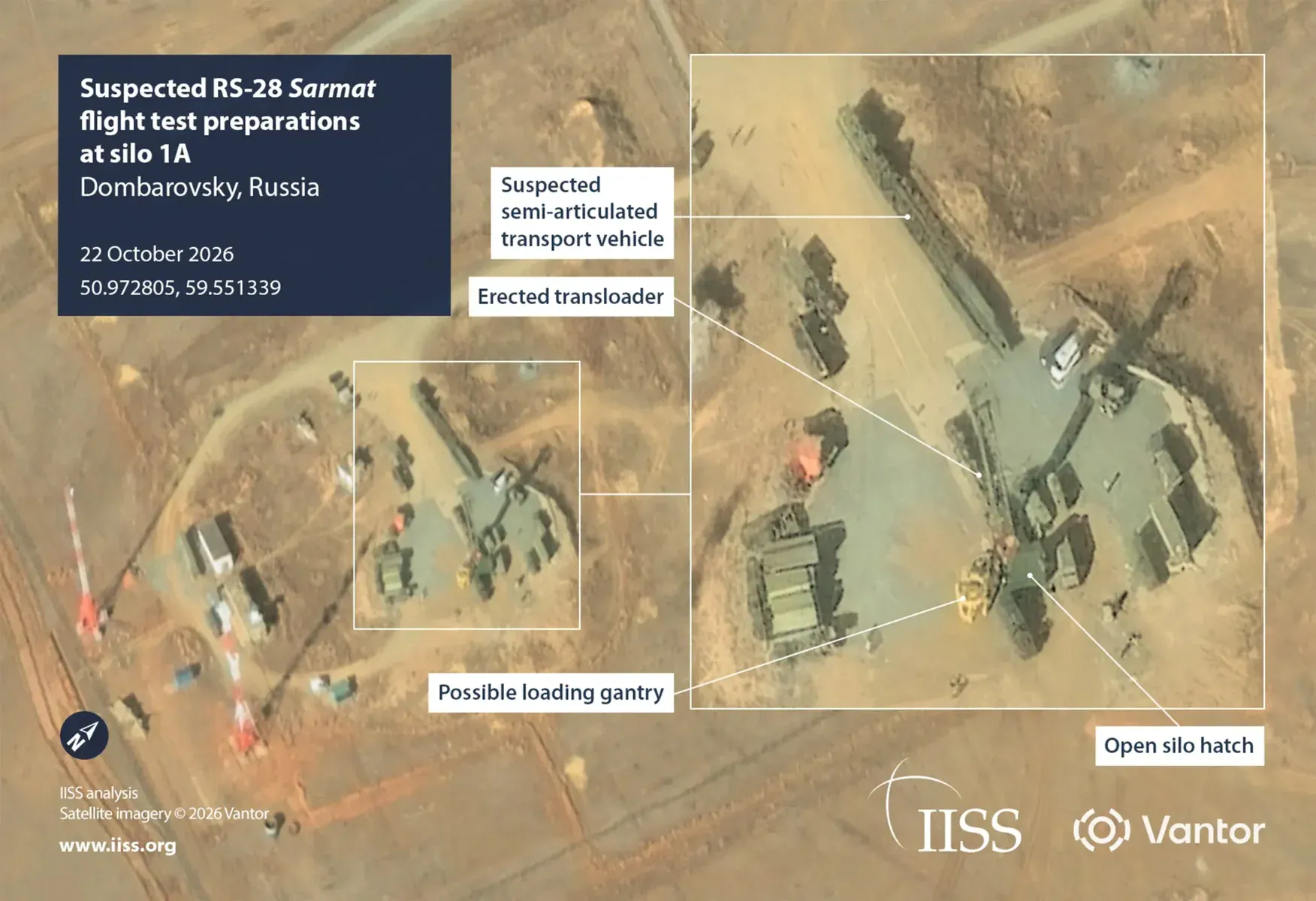
The analysis is based on satellite images dated 6 June 2026. They show at least six transport and support vehicles near the open silo launcher No. 13C near the town of Uzhur, Krasnoyarsk Krai, Russia.
The 62nd Missile Division of Russia’s Strategic Missile Forces is based there and is scheduled to receive the new missiles.
A specialized transporter-erector designed to transport and load intercontinental ballistic missile sections was spotted directly next to the silo.

Its loading platform was positioned almost vertically, but the missile section had already been removed.
A separate vehicle was also observed carrying a red protective casing approximately three meters in diameter, used to transport missile sections.
According to the IISS assessment, this may indicate that one of the missile sections has already been loaded into the silo.
The deployment of the new missiles comes after prolonged problems with their development and testing. The first successful launch of the Sarmat took place in April 2022, while the second was conducted on May 12, 2026.
Between these launches, Russia experienced at least two failures. In September 2024, a missile exploded inside its launch silo at the Plesetsk test range. In November 2025, the Sarmat reportedly lost control after emerging from its silo and crashed nearby.
Despite the missile’s reliability issues, following the successful May test, Strategic Missile Forces Commander Sergei Karakayev told Putin that the Sarmat system could enter combat duty by the end of 2026.
This haste may be explained by Russia extending the service life of its existing liquid-fuel intercontinental ballistic missiles by more than 20 years, making their continued operation increasingly risky and reducing their reliability.


